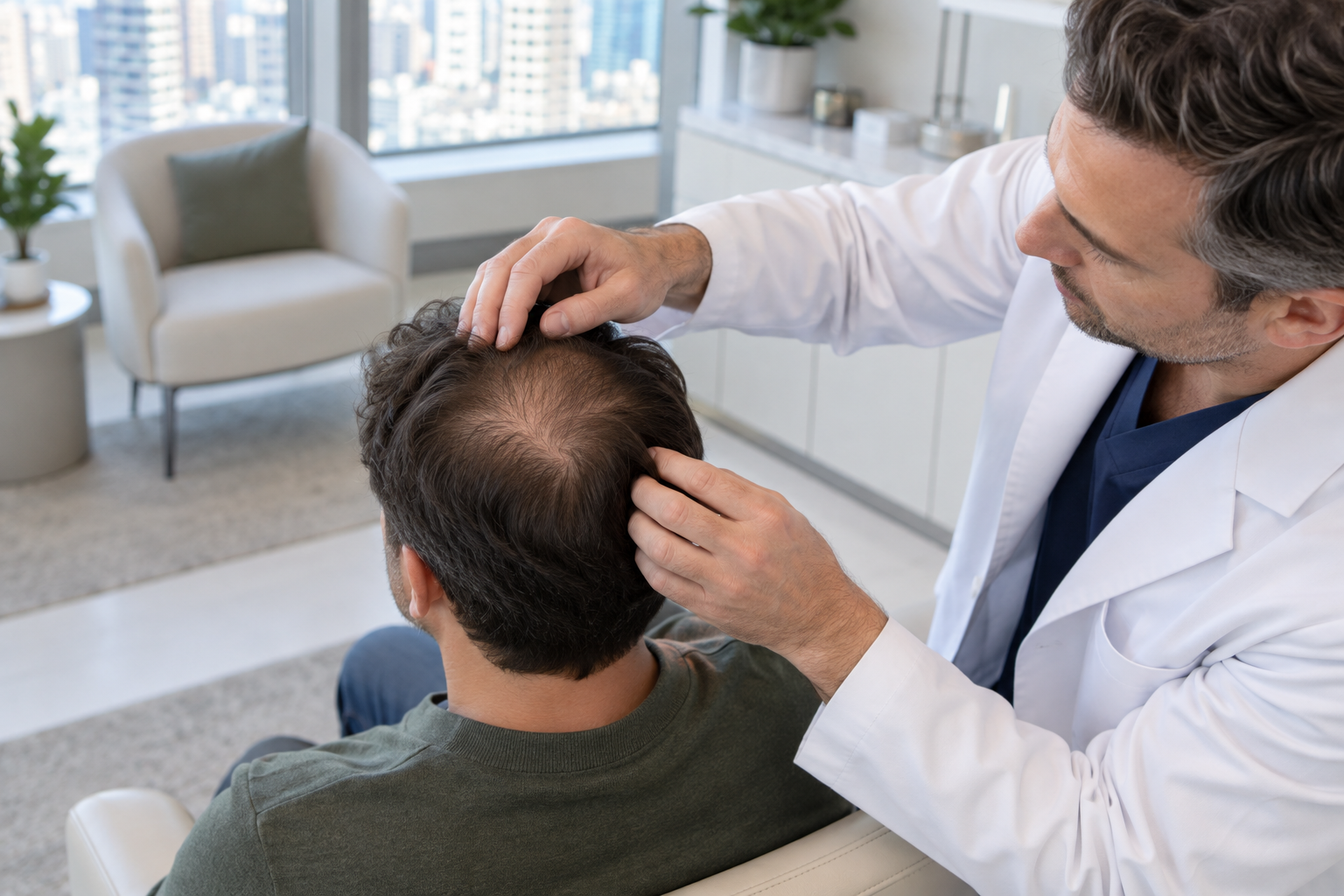
A hair transplant for crown baldness can restore coverage for suitable patients by moving healthy follicles from a donor area to the top-back region of the scalp, also called the crown or vertex. The procedure must be planned carefully because the crown can cover a broad area, follows a spiral growth pattern, and may continue expanding as pattern hair loss progresses.
Good crown restoration is not simply about placing as many grafts as possible. The plan must balance visible improvement with natural direction, realistic density, and preservation of a limited donor supply. An in-person assessment in New York can determine whether surgery, medical management, monitoring, or a combination approach makes sense for the individual patient.
Why Is the Crown Different From the Hairline?
The crown sits toward the back of the top scalp and usually contains a natural swirl or whorl. Hair changes direction around the center of this pattern. Recipient sites must follow those changing angles so the transplanted hair blends with existing growth rather than appearing to point in one uniform direction.
The area can also be deceptively large. A circular region increases quickly in surface area as it expands, which means a more advanced crown bald spot may require many grafts to create even moderate visual coverage. The front hairline, by contrast, has a stronger effect on facial framing and may receive priority when the donor supply is limited.
For this reason, an ethical crown plan considers the entire scalp. A clinician should evaluate current loss at the hairline, mid-scalp, and crown; estimate how the pattern could progress; and reserve donor follicles for potential future needs.
What Causes Crown Baldness?
Pattern hair loss is a common cause of gradual thinning at the vertex. In men, it may begin as a small spot at the crown and expand over time. The clinic’s overview of male pattern baldness and crown thinning explains how progressive loss can affect the top of the scalp.
However, not every crown concern is androgenetic alopecia. Diffuse shedding, inflammatory or scarring scalp conditions, medication effects, nutritional problems, traction, autoimmune disease, and other medical issues can also reduce density. Women may experience diffuse thinning across the upper scalp rather than a clearly defined circular bald spot.
Diagnosis comes before surgery. A medical history and scalp examination help determine the pattern, activity, and likely cause of the loss. Some patients may need additional evaluation before a transplant is considered. Placing grafts into an unstable or actively inflamed scalp can produce an unpredictable result.
Who May Be a Candidate for a Crown Hair Transplant?
Candidacy is individual, but a suitable patient generally needs a confirmed diagnosis, a reasonably predictable pattern, a healthy scalp, enough stable donor hair, and realistic expectations about coverage.
- Donor density: The back and sides of the scalp must provide enough appropriate follicles without creating obvious thinning in the donor area.
- Extent of crown loss: A small or moderate area usually requires fewer grafts than a large vertex extending into the mid-scalp.
- Hair characteristics: Strand thickness, curl, color contrast, and the number of hairs within each follicular unit affect the appearance of coverage.
- Age and progression: Younger patients with rapidly changing loss may need a more conservative plan because the future pattern is harder to predict.
- Overall priorities: Hairline or mid-scalp restoration may have greater visual impact and may need to be addressed before the crown.
- Health and healing: Medical conditions, smoking, medications, and scalp disorders can influence safety and recovery.
A crown transplant is not appropriate for everyone with a visible whorl. Some scalps naturally show more skin at the center of the spiral, especially under bright overhead lighting or when hair is wet or separated. A professional assessment can distinguish a normal crown pattern from true miniaturization and progressive loss.
How Is a Natural Crown Whorl Recreated?
The crown does not grow in straight rows. Hair rotates around one or sometimes more whorl centers, with angles becoming flatter as strands move outward. During vertex hair restoration, the treatment team maps this pattern and creates recipient sites that follow the patient’s existing direction.
Natural design depends on more than the whorl center. The transition into the mid-scalp should look gradual, and grafts should be distributed to avoid a sharp circle of dense hair surrounded by future thinning. If native hair remains, placement must protect and blend with those follicles while accounting for possible continued loss.
Visual density is also different from original biological density. A transplant redistributes a limited number of follicles and usually cannot recreate the exact density a patient had before hair loss. Strategic angles, hair caliber, curl, and layering can create the appearance of useful coverage without exhausting donor reserves.
FUE Versus FUT for Crown Restoration
Both follicular unit excision and follicular unit transplantation can provide grafts for a crown procedure. The better option depends on donor characteristics, graft needs, scarring preferences, hairstyle, prior procedures, and the long-term plan.
FUE for the crown
With FUE, follicular units are removed individually through small extraction sites. The clinic’s guide to FUE hair transplantation in NYC describes the procedure and recovery. FUE avoids a linear donor scar, but it is still surgery and leaves small extraction scars. Harvesting must be spread carefully to reduce the risk of visible donor thinning.
FUT for the crown
With FUT, a strip of donor-bearing scalp is removed and divided into follicular unit grafts. The clinic’s FUT hair transplant overview discusses strip harvesting, the linear donor scar, healing, and candidacy. FUT may help obtain a larger graft supply in some plans, but scalp laxity, scar history, and hairstyle preferences matter.
Neither method automatically produces better crown density or longer-lasting results. Graft selection, handling, recipient-site design, placement angle, healing, and future hair loss are central to the outcome.
How Many Grafts Does a Crown Hair Transplant Need?
There is no reliable universal number. Graft needs depend on the size and shape of the thinning area, the amount of existing miniaturized hair, desired coverage, donor supply, hair characteristics, whorl design, and whether the hairline or mid-scalp also needs treatment.
A clinician may discuss a staged approach when the crown is extensive or the future pattern is uncertain. The first stage can improve the most visible portion while preserving options. A later procedure may be considered after growth and hair-loss progression are reassessed.
Patients should be cautious with estimates based only on a photograph or a generic graft calculator. Images can help begin a conversation, but lighting, hair length, styling, and camera angle can make the crown look smaller or larger than it is. Direct measurement and donor examination provide a stronger foundation for planning.
What Happens During the Procedure?
- Planning: The clinician reviews the diagnosis, maps the crown and whorl, estimates graft needs, and confirms donor limits.
- Preparation and anesthesia: The scalp is prepared, and local anesthesia is used according to the treatment plan.
- Harvesting: Grafts are obtained with FUE or FUT and handled carefully to protect follicle viability.
- Recipient-site creation: Small sites are made at changing angles that reflect the natural crown pattern.
- Placement: Follicular units are inserted into the planned sites to build gradual coverage and blend with native hair.
- Aftercare: The patient receives instructions for washing, sleeping, activity, medication, and follow-up.
Procedure length varies with the technique and number of grafts. Some plans may involve more than one session. Patients should understand who will perform each surgical step and how the clinical team will monitor graft handling and placement.
Crown Hair Transplant Recovery and Growth
Early recovery often includes redness, small scabs, tenderness, or swelling. The transplanted hair shafts commonly shed in the weeks after surgery while the follicles remain beneath the skin. New growth then appears gradually.
- Days 1 to 14: The recipient and donor areas heal; careful washing and protection are important.
- First several weeks: Shedding of transplanted hairs may occur.
- Months 3 to 4: Early growth may begin, often fine and uneven at first.
- Around month 6: More visible growth and thickening may develop.
- Months 9 to 12 and beyond: The crown continues maturing; individual timing varies.
Because crown hairs lie at flatter angles and overlap around a spiral, the final visual effect takes time to judge. The clinic’s hair transplant recovery timeline offers additional context, but each patient’s postoperative instructions should come from the treating clinician.
How Long Do Crown Transplant Results Last?
Successfully transplanted follicles selected from a stable donor zone can provide growth for many years and may last for life. Still, no result is guaranteed. Graft survival varies, individual strands can become finer with age, and follicles taken from the edge of an unstable donor area may be less durable.
The larger long-term concern is often the native hair around the transplant. Pattern hair loss can continue, causing the crown to expand or creating a thinner ring around transplanted grafts. A durable result therefore requires a plan for potential future loss rather than treating the current bald spot in isolation.
Medical treatment may be discussed to help manage ongoing pattern loss, but prescription and nonprescription options have different benefits, risks, and contraindications. Patients should not start or change treatment without an individualized medical discussion.
Risks and Limitations to Understand
Hair transplantation is surgery. Potential issues can include bleeding, infection, scarring, temporary shedding, numbness, swelling, poor graft growth, an unnatural direction, uneven density, or dissatisfaction with coverage. FUE and FUT create different donor scars, and neither method is scar-free.
Crown-specific limitations include the number of grafts required for a large circular area, the challenge of recreating a whorl, and the risk that continuing loss will enlarge the untreated zone. Dense packing is not always safe or realistic, particularly where blood supply, existing hair, or donor limits are concerns.
Before-and-after photos can help illustrate a clinician’s work, but another patient’s outcome does not predict yours. Compare cases with similar crown size, hair characteristics, loss pattern, and time since surgery, and ask whether images use consistent lighting and angles.
Questions to Ask at a New York Crown Consultation
- What is causing my crown thinning, and is the diagnosis stable enough for surgery?
- How large is the treatment area, and how might it change over time?
- Should the crown, mid-scalp, or hairline receive priority?
- How will you recreate my natural whorl direction?
- What level of coverage is realistic with my donor density and hair characteristics?
- Why do you recommend FUE, FUT, or a staged plan for me?
- How much donor hair should remain reserved for future loss?
- Who performs the harvesting, recipient-site creation, and graft placement?
- What scars, recovery steps, risks, and follow-up visits should I expect?
- Could medical management or monitoring be appropriate before or after surgery?
Frequently Asked Questions
Can a hair transplant fill a bald crown?
It can improve coverage for an appropriate candidate with sufficient donor hair and a suitable diagnosis. The achievable density depends on the crown’s size, existing hair, donor supply, hair characteristics, and long-term priorities.
Why can the crown require many grafts?
The crown may cover a broad circular area, and its surface area grows quickly as the bald spot expands. Grafts must also follow a spiral pattern, so strategic distribution is important.
Is FUE better than FUT for crown baldness?
Not universally. Either method can supply grafts for the vertex. The choice depends on donor anatomy, graft needs, scarring preferences, hairstyle, previous surgery, and future planning.
Will crown hair loss continue after a transplant?
Native hair can continue thinning because a transplant does not stop the underlying condition. Long-term planning may involve monitoring, medically appropriate treatment, or additional surgery.
When will the crown look fuller?
Early growth may begin after several months, with more visible change around six months. Maturation often continues through 9 to 12 months and sometimes longer. Timing and density vary.
Can women have a crown hair transplant?
Some women may be candidates, but diffuse thinning can affect the donor area and requires careful diagnosis. A clinician should determine the cause of loss and whether a stable donor supply exists.
Discuss Crown Hair Restoration in Manhattan
Crown restoration works best when the whorl, donor supply, current pattern, and future loss are evaluated together. Hair Transplant Specialists – New York City can assess the scalp, discuss realistic coverage, compare FUE and FUT, and explain whether surgery or another approach is appropriate. To review your options at the Manhattan office, request a private crown hair transplant consultation.
This article provides general education and does not replace a diagnosis or individualized medical advice. Candidacy, recovery, graft growth, and cosmetic results vary.